Confidential Strategic Analysis
Cybersecurity Market Landscape 2026
REF: CQ-2026-X-ALPHA

Sentinext-Q and the Strategic Re-Architecting of Global Cybersecurity
The global cybersecurity landscape in early 2026 is defined by a state of 'digital hyper-fragmentation,' where the collision of agentic AI and post-quantum threats demands a new sovereign architecture.
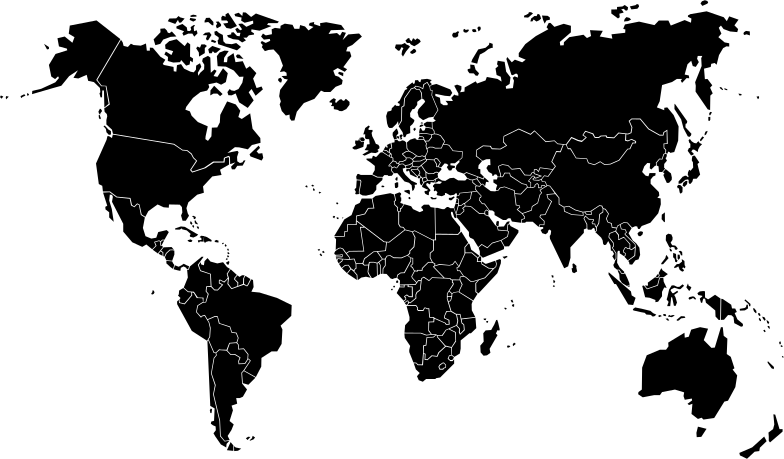
The fragmenting of global networks has birthed 'Jurisdictional Bunkers'—regions like Switzerland and Singapore that offer immunity from extraterritorial data access.
Sentinext-Q is the first platform to offer native surveillance for the Model Context Protocol (MCP), securing AI agent tool-calling against prompt injection and credential escalation.
With the acceleration of quantum decryption timelines, Sentinext-Q implements FIPS 203, 204, and 205 (ML-KEM, ML-DSA) to protect against 'Harvest Now, Decrypt Later' strategies.
Disrupting the industry's consumption-based pricing, Sentinext-Q offers a fixed Total Cost of Ownership model, resulting in up to 90% savings compared to legacy hyperscalers.
Operational Cost Comparison (Monthly USD)
Enterprise security is shifting from a sunk cost to an operational predictability driver. CyberQuant's fixed TCO model eliminates 'cloud tax' and scaling penalties.
Architectural Alignment Analysis
Sentinext-Q outperforms legacy architectures in sovereign dimensions: Post-Quantum Resilience, AI-Native Surveillance, and Jurisdictional Isolation.
Distributed Jurisdictional Architecture
A mesh of isolated jurisdictional bunkers (Singapore, Switzerland, Iceland) ensuring total immunity from extraterritorial data seizure.
Our deep-dive report includes detailed competitive benchmarks against Microsoft Sentinel, Splunk, and CrowdStrike, along with financial framework analysis using the Gordon-Loeb model.
Confidential Strategic Analysis
REF: CQ-2026-X-ALPHA